


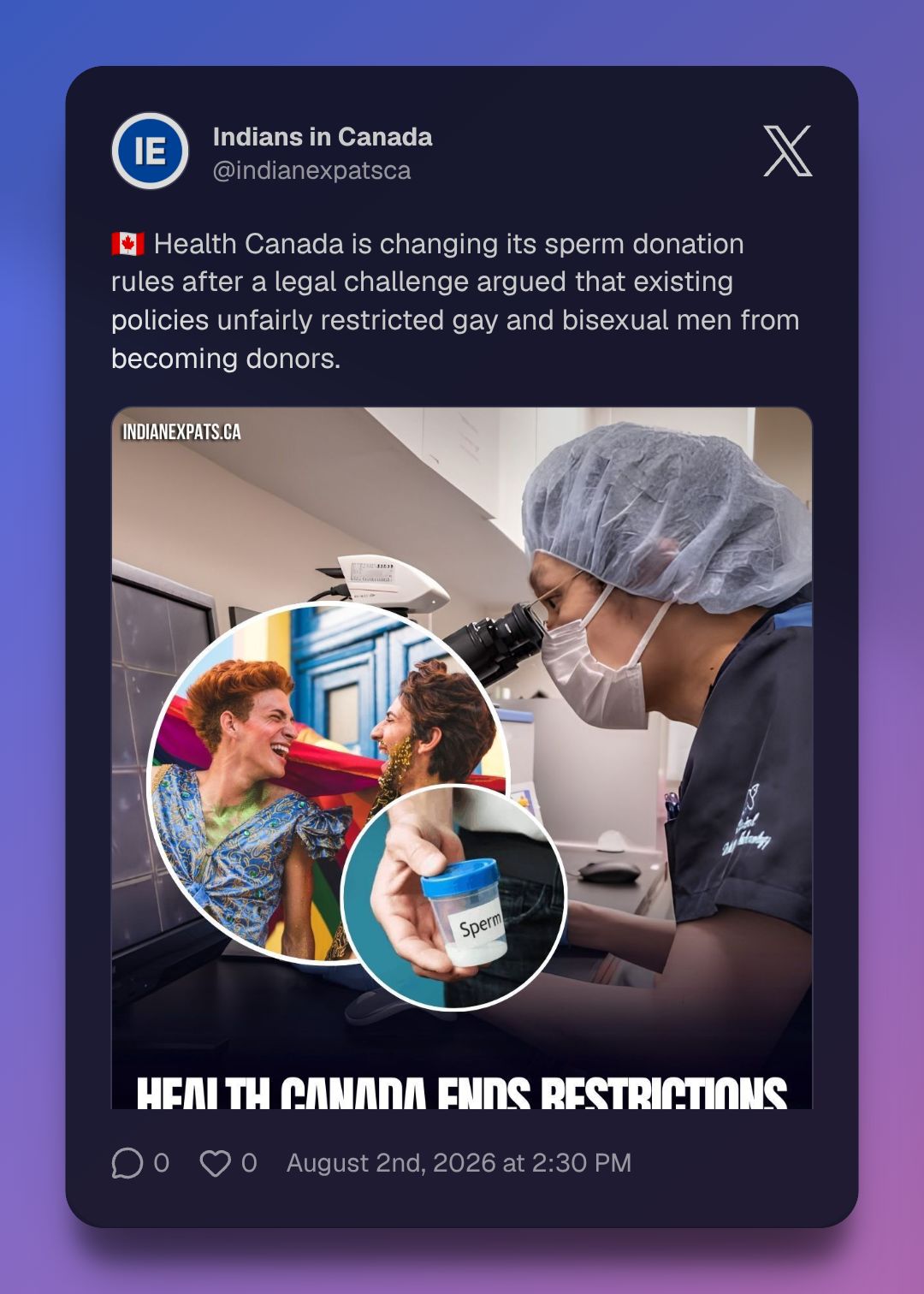
Sperm donation in Canada has entered a new chapter after Health Canada officially removed the remaining sexual behavior-based screening questions that disproportionately affected gay and bisexual men. The decision marks another significant shift toward a more individualized approach to donor eligibility and has been welcomed by LGBTQ+ advocates who have spent years pushing for change.
For one man, however, the story is deeply personal.
A man named Aziz first donated sperm in 2014 to help a family have a child, describing the experience as one of the most rewarding moments of his life. Speaking with CTV News, he said the birth of the child enriched his life and inspired him to encourage other queer friends to consider becoming donors themselves.
There was just one problem.
Many of them couldn’t.
READ: Blood Ban Barriers Fall Globally as LGBTQ Donors Gain Fairer Access
From Personal Experience to Public Challenge
When Aziz made his donation in 2014, he was not publicly out as a gay man. At the time, Health Canada’s rules barred sperm donations from men who had engaged in sex with another man within the previous three months, citing concerns about HIV and other sexually transmitted infections.
As Aziz watched friends become ineligible under the policy, he decided to challenge it.
In 2023, he launched a constitutional case arguing that the restrictions unfairly discriminated against gay and bisexual men. While Health Canada removed its blanket ban in 2024 and revised its screening language to make questions about anal sex gender neutral, Aziz and his legal team chose to continue their challenge.
According to Aziz, the updated policy still has the potential to disproportionately affect the same community, even if the wording itself is no longer explicitly targeted.
Science Has Changed Too
Health Canada’s latest announcement goes a step further by eliminating the remaining sexual behavior-based screening questions that had continued to affect many potential LGBTQ+ donors.
The agency also updated its donor testing requirements by requiring advanced screening technologies capable of detecting infectious diseases such as HIV, hepatitis B, and hepatitis C.
Those scientific advances are important because every sperm donation already undergoes a rigorous safety process. Samples are tested for infectious diseases when collected, placed in quarantine for a minimum of 180 days, and tested again before being released for use.
Several medical experts involved in Aziz’s court case have argued that this extensive testing system for sperm donation is already robust enough to identify unsafe donations without relying on broad assumptions based on sexual orientation or specific sexual behaviors.
A Bigger Win Than One Policy
For LGBTQ+ people, the announcement represents more than a regulatory update.
It reflects years of advocacy aimed at replacing identity-based restrictions with evidence-based screening that evaluates each donor as an individual rather than judging risk through stereotypes.
Aziz’s constitutional challenge may still continue, but the landscape has already shifted dramatically from the rules that existed when he quietly donated sperm more than a decade ago.
His story also serves as a reminder that lasting policy changes often begin with personal experiences. One act of generosity helped create a family. Years later, that same experience helped spark a broader conversation about fairness, inclusion, and who gets the chance to give someone else the gift of parenthood.